
To measure sunlight on your balcony, check the exact places where pots could sit and add up the time direct sun reaches the leaves. Use a clear day, mark two or three positions, and note when each moves into sun or shade. If a corner gets sun in the morning and again after lunch, add the two sunny periods and leave out the shaded gap.
A balcony can look bright while the railing shades a low pot. The opposite can also happen: a tall plant catches sun above the railing while its pot stays shaded. Measure where the plant will grow. That gives you a better basis for choosing a vegetable than a compass direction or a glance around noon.
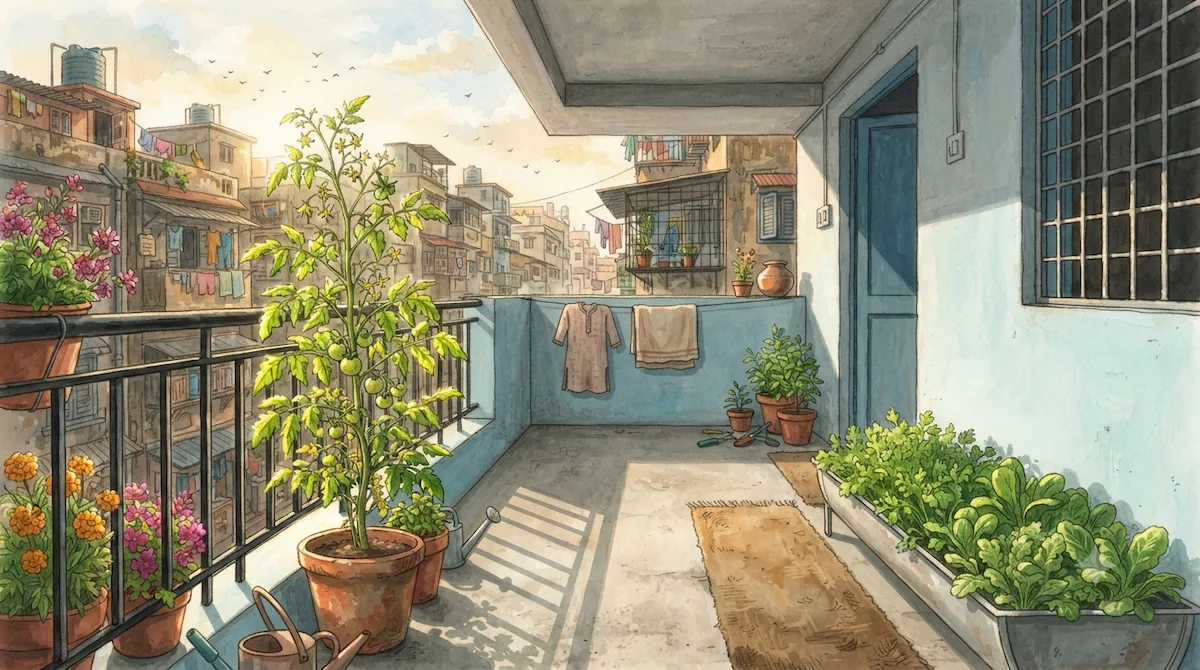
What counts as direct sunlight?
Direct sunlight reaches the leaf position in a beam from the sun. To check safely, hold your hand or a piece of card above the proposed growing spot and look at the shadow it casts. A clearly defined shadow in a spot lit by the sun is a good clue. If the area is bright but your hand casts only a soft shadow because the wall or roof blocks the beam, record bright shade. You do not need to look toward the sun.
Under a leafy tree, small sun patches can move in and out of the same spot. Record that as dappled light if the beam only reaches parts of the canopy for short spells. Bright shade and dappled light still matter to the plant, but count them separately when you compare your total with advice stated in hours of direct sun. If you cannot tell because a cloud has moved across the whole balcony, write “cloud” and return to the spot when the sky clears.
Mark the spots and heights you can actually use
Draw a small plan on paper. Mark the railing, door and any overhang. Add the direction you face if you know it, then note anything that casts a shadow: the next building, a tree, a privacy screen or a tall planter. Leave a clear path, keep all pot positions stable and use only areas your building allows you to use. There is little point in measuring a sunny railing top that you cannot safely use for a container.
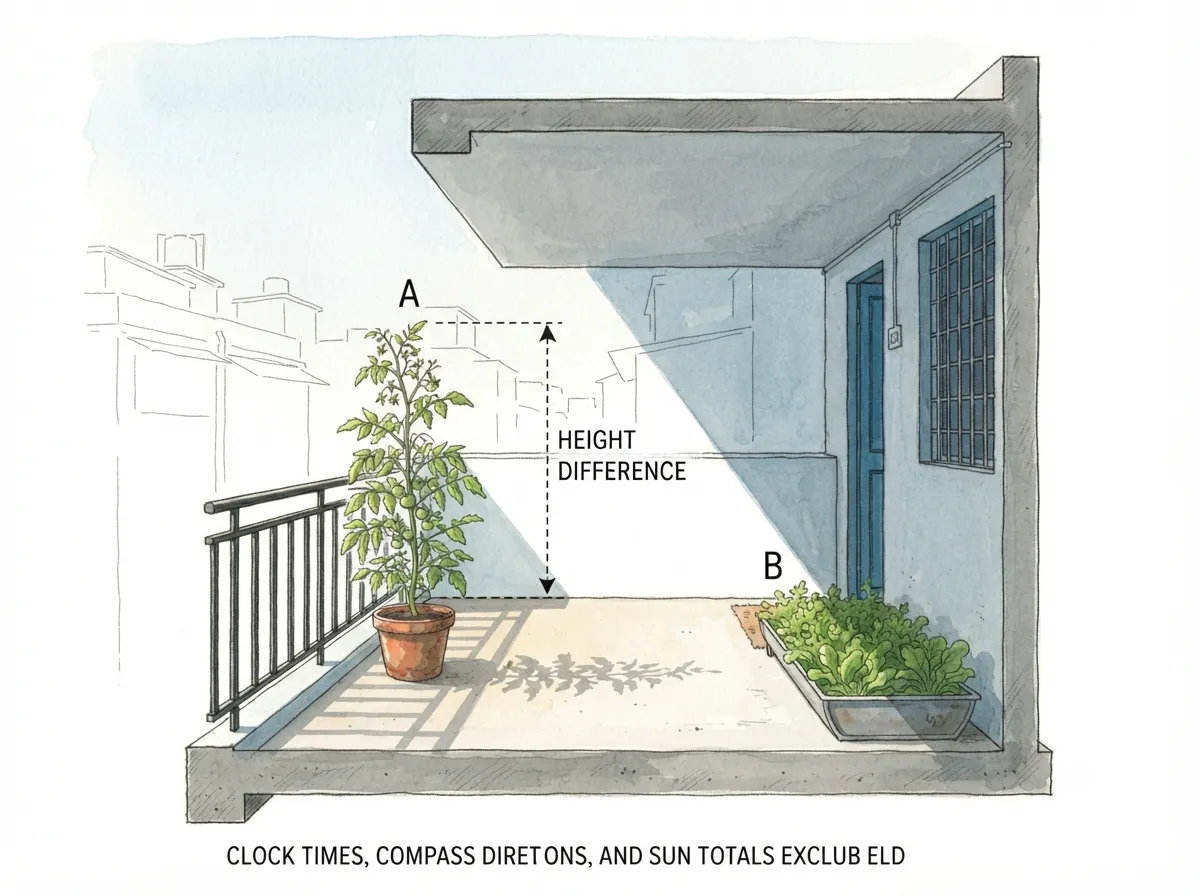
Label two or three promising positions. A useful start might be A by the railing, B one pot-width farther back, and C near the side wall. An empty pot or a piece of card can help you find the same point at every visit. You can set a second card at roughly the height of the leaves if you are considering a tall plant. For a low tray of greens, check just above the top of its future growing mix. You are comparing positions other pots could occupy, so write down both the point and the height you chose.
If an existing tomato cage or screen will stay, leave it in position while you check. If you are planning to move it, take a second reading afterward. Changing the layout during the day makes it harder to tell whether the light changed because the sun moved or because you moved the obstacle. The University of Tennessee Extension guide to small-space food production shows why sun angle affects how deep a beam reaches into a balcony or porch.
Make a one-day sun log
- Choose a mostly clear day near the season you want to plant. Write down the date and anything temporary that changes the light, such as a rolled-down shade or a neighboring tree in leaf.
- Start early enough to catch first light at your marked positions. Check about every half hour if you can. An hourly round can show the broad pattern if you only need to compare spots.
- At each round, mark each spot as direct sun, bright or dappled shade, or uncertain. Check the same height and point every time. Write down when direct sun begins or ends if you see the edge of a shadow pass.
- Pay closer attention around a change. If one spot was sunny at 9:00 and shaded at 9:30, you know the change fell within that half hour. Check sooner the next day if the difference affects a crop choice.
- Add the sunny intervals for each position separately. Do not combine times from two positions into one total unless you intend to move the same plant between them and have checked that the move reliably works.
Illinois Extension’s sun-chart activity uses repeated observations to reveal what a single look misses. Use your phone for alarms or photos if that makes the job easier. Keep pictures aimed at the same marks so you can compare the shadow rather than trying to judge which photo looks brighter.
Add the intervals without counting the shaded gaps
Here is a made-up example that shows the arithmetic. These are sample times for two positions, so use your own log to choose crops.
| Position | Direct sun intervals | Total | What to test next |
|---|---|---|---|
| A near the railing, at mature leaf height | 8:00–10:15 a.m. and 12:45–4:45 p.m. | 6 hours 15 minutes | Candidate for a fruiting crop in a suitable season. Check wind and afternoon heat. |
| B farther in, above a low trough | 8:30–10:00 a.m. and 1:30–3:30 p.m. | 3 hours 30 minutes | Try a small pot of loose-leaf lettuce if local conditions suit it. Growth may be slower or the harvest smaller than at a sunnier spot. |
At A, the first spell lasts 2 hours 15 minutes and the second lasts 4 hours. The time between them is shade. By using those intervals, you avoid mistaking the span from 8:00 in the morning to 4:45 in the afternoon for 8 hours 45 minutes of sun.
Real logs have rough edges. Suppose you saw sun at 2:30 and 3:00, followed by shade at 3:30, with no check between readings. The end of that sunny interval fell between 3:00 and 3:30. If you started timing at 2:30, count 30 to 60 minutes from that point. Note the range instead of choosing an exact minute. If your estimate is close to a threshold, spend the next clear day watching that transition and any other uncertain spell. You can also make a low-cost trial with one pot while keeping the rest of the space free.
Use the result to pick a first crop
Oregon State Extension’s container gardening guide recommends roughly 6–8 hours of direct sun for fruiting crops such as tomatoes and peppers. If you have a spot in that range and the weather suits the crop, it is a sensible first place to try one. Check how much space the mature plant needs before you buy. Our tomato grow-bag guide helps match the container to the plant after you find a workable location.
Leaf crops tolerate more shade. A position with only a few hours of direct sun can be worth a small trial with a local leafy vegetable when its planting season is right. If the best low position has almost no direct sun, try another safe location before investing in several containers. In India, use the companion guide to winter vegetables that fit your pots and conditions once you know how much light the position gets.
Read the light total alongside the time of day. A hot wall can make a west-facing pocket warmer than another spot with the same total in the morning. If plants wilt repeatedly there, check the moisture inside the pot and how fast it dries before watering more. You may decide that a stable morning-sun spot fits a leaf crop better. For a crop that needs more sun, reserve the stronger position and give it a pot you can water and check without reaching over the railing.
When to measure again
Repeat the check near your next planting season, after building work changes a shadow, or when a tree or your own climbing plants fill in. In some seasons, the sun shines lower under an overhang and reaches farther across the floor. At the same time, a nearby building may block it earlier in the day. That is why a seasonal change is worth measuring instead of guessing which way it will go.
After you plant, check the spots again while a tall crop is growing. A tomatoes-and-greens arrangement can work one month and leave the greens shaded when the tomato reaches its support. Try shifting the smaller pot to a clear, stable position and repeat the observation before you commit to another sowing. A dated picture with the plant and its shadow in view can help you compare the old and new layout.
Do you need a sunlight app or a meter?
A sun-path app can help you decide when to look, particularly if you cannot be home for every observation. A forecast of the sun’s position still needs a check against the edge of your own roof, screen or tree canopy. A phone brightness reading tells you about a moment at the sensor. It does not tell you when a moving shadow arrived, so keep separate notes if you use it.
For a first vegetable garden, a dated record is enough to answer the question that matters: where should this pot go? Beside each position, write its approximate total, whether the sun falls mostly in the morning or afternoon, and the crop you plan to try. Leave the next line blank for a second check when your planting season changes. You’ll know whether the next pot belongs beside the first one or in a different spot.